
Receiving & screening
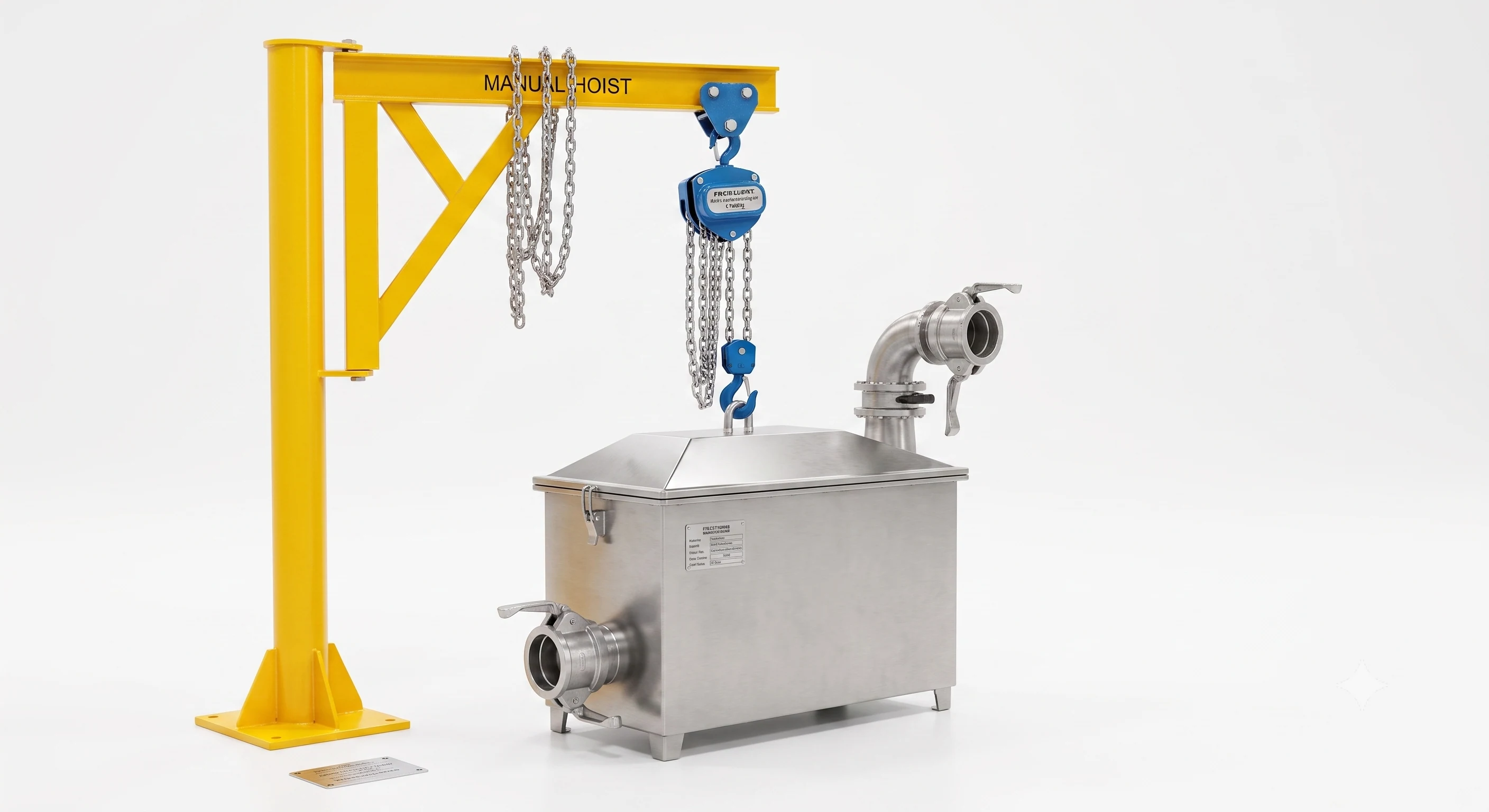
A receiving housing directs incoming wastewater through a removable perforated basket, retaining gross solids for periodic removal.
TANKER RECEIVING / GROSS-SOLIDS SCREENING
A family of sewage-tanker receiving and screening units with removable baskets. Standard capacities range from 20 to 160 m³/h, with larger sizes available to suit the project.
TECHNOLOGY & CONFIGURATION
SRS units receive tanker-discharged sewage and intercept gross solids before the downstream receiving or treatment system. Unit size, screening aperture, connections and handling arrangements are selected around peak unloading flow, solids loading and site access.
A receiving housing directs incoming wastewater through a removable perforated basket, retaining gross solids for periodic removal.
Select from the 20–160 m³/h standard range, or specify a larger size. Inlet and outlet sizes and coupling interfaces follow the unloading duty.
Screen openings from 10 to 50 mm and SS304 or SS316 construction support selection for the incoming solids and wastewater characteristics.
Access covers and basket-removal clearance are coordinated with the installation. Optional manual lifting assistance can be included for basket handling.
PRELIMINARY SELECTION
Published ranges support initial selection. Final equipment, dimensions, materials and performance commitments follow the confirmed project requirements.
| Selection parameter | Product family range / options | Selection basis |
|---|---|---|
| Application | Sewage tanker receiving and gross-solids screening | Protection of downstream receiving and treatment stages |
| Standard capacity | 20–160 m³/h | Peak unloading flow and available hydraulic head |
| Larger capacities | Larger sizes available | Project-specific hydraulic and solids-handling requirements |
| Screen openings | 10 / 20 / 30 / 40 / 50 mm | Incoming solids and downstream protection |
| Construction | SS304 or SS316 stainless steel | Wastewater chemistry and project specification |
| Connections | Sizes and coupling interfaces selected by duty | Tanker hoses, receiving pipework and backpressure |
| Housing and basket | Dimensions selected for the required capacity | Footprint, solids holding volume and cleaning access |
| Basket handling | Removable basket; optional lifting assistance | Basket weight, lifting clearance and operating procedure |
The range supports preliminary selection. Achievable unloading flow depends on hydraulic head, tanker discharge conditions, hoses, downstream backpressure and solids accumulation. Dimensions, connection sizes and any pressure limits are confirmed for the selected unit.
PROCESS & SUPPLY BOUNDARY
Supply inclusions and options are confirmed in the agreed quotation. Installation, commissioning and operation are available in Jordan, Iraq and the UAE; installation supervision and commissioning are available in other countries.
REQUEST A QUOTE
COMMON QUESTIONS
The standard SRS range is 20–160 m³/h. Larger sizes are available; final selection considers peak unloading flow, available head, solids loading and downstream conditions.
SRS is a receiving and gross-solids screening stage. Biological treatment, fine filtration and other treatment stages are selected separately.
Openings from 10 to 50 mm are selected for the incoming solids and downstream protection required. SS304 or SS316 construction is selected for wastewater chemistry and the project specification.
The removable basket requires periodic inspection and cleaning. Cleaning frequency follows the actual solids accumulation during operation.
Manual lifting assistance is optional. The lifting arrangement, capacity, clearance, anchoring and any certification requirements are confirmed for the selected unit and site.